
 Kyle Hudson, Co-Founder & CEO
 When should a startup start caring about AI search? Before the website
A new company starts with zero online presence. Here's why publishing a Day-One Library: tools, partners, and honest comparisons; beats building a website first.
Your company is three weeks old. There is a name, a legal entity, a product taking shape, and a launch list with "website" near the top, slated for next quarter.
Meanwhile, the people you plan to sell to are already asking questions. A short-term rental manager asks an assistant which tools handle guest messaging. A founder in an adjacent space asks what integrates with the platform you build on. Those answers get assembled from whatever is public, crawlable, and specific. You appear in none of them: you have published nothing.
The instinct is to call this a launch-week problem: website first, discovery later. This guide argues the opposite. The fastest discoverable asset a new company can create is a public, browsable hub of what the team already knows: the tools you chose, the partners you work with, the questions you can already answer. Consider it your first indexable asset, live before the homepage exists.
What does an AI assistant know about a company that incorporated yesterday?
Nothing. Not a hostile nothing, a literal one. There is no page to retrieve, no entity to resolve, no source to cite. Every recommendation engine, whether it is a classic search results page or a generated answer, works from an index of published material, and a new company has contributed exactly zero entries to it.
Consider how Kyle Hudson, Stacklist's founder, puts it: "On the day you incorporate, you are completely invisible. When you build your website, you're also going to be competing with a trillion other websites. If you immediately create a resource library of all your knowledge, recommendations, partners, services, and everything from day one, you could actually start getting indexed and cited the first week if the content is good."
Two claims are packed in there, and they deserve different levels of confidence. The first, that a new company starts from literal zero and that a homepage enters a brutally crowded contest, is just how indexes work. The second, that a good resource library can start getting indexed and cited within its first week, is Kyle's experience-based view from watching new content get picked up, not a measured benchmark. Crawl cadence varies by site, topic, and how discoverable your pages are. Treat the first week as a realistic possibility to aim for, not a promise.
What matters is the direction of the logic: visibility compounds from the first indexable page. Every week without one is a week the compounding has not started.
Why is a resource library faster than a website?
Because of what each one competes against.
A homepage answers one question: "what is this company?" Almost nobody is asking that question about you yet, and the broader queries a homepage might match ("best property management software", "top booking tools") are contested by every established company in the category. A brand-new domain entering that contest starts at the back.
A resource library answers dozens of narrow questions: "what messaging tool works with this booking platform?", "which payment provider suits a two-person company selling to hotels?", "what does this integration actually cost to maintain?" Many of those questions have thin, generic, or outdated answers today. That is where a new company can be the strongest source available, immediately.
The mechanics support this. Google's official guide to succeeding in its generative AI features explains that AI answers are "rooted in our core Search ranking and quality systems": the model retrieves relevant, up-to-date pages from the search index (retrieval-augmented generation) and issues a set of concurrent, related sub-queries (query fan-out) to cover the user's question from multiple angles. One user question becomes many specific retrievals. Specific pages match specific retrievals; homepages mostly do not.
The same guide is explicit about what kind of content earns retrieval: unique, non-commodity material grounded in first-hand experience, the kind that "could not easily be produced by a generative AI model." A founder's honest account of which tools they evaluated and why they picked one is exactly that. A generic "welcome to our blog" post is exactly not.
So the day-one move is not "write content." It is: publish the knowledge you already paid for by building the company.
What goes in the Day-One Library?
We call the framework the Day-One Library: five content types a founding team can publish before the website exists, because every one of them is already sitting in your heads, your vendor contracts, and your group chat.
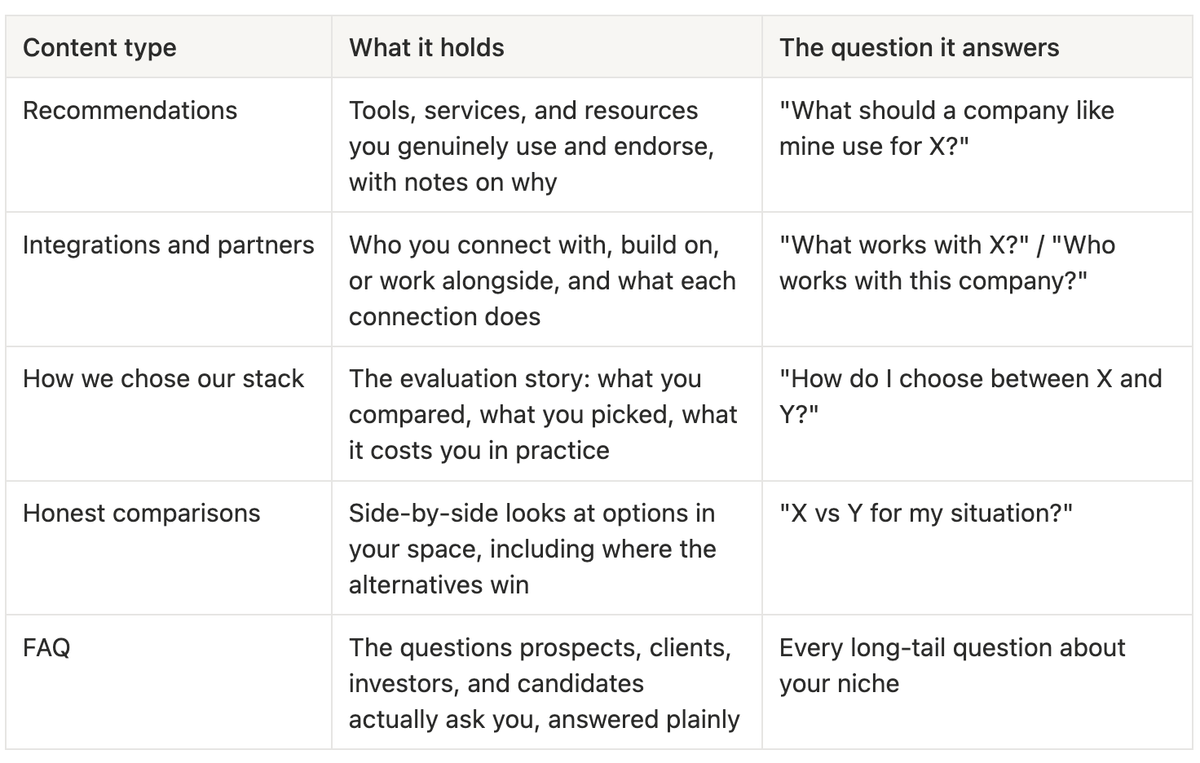
Notice what is not on the list: news, launch announcements, thought-leadership takes. Those have their place later. None of them matches a question a stranger is asking an assistant this week.
Two of the five deserve a caution. "How we chose our stack" and "honest comparisons" only work if they are honest. Name the trade-offs, say where the option you rejected is the better fit for someone else (a hotel operator with different needs, for instance), and keep the tone of a practitioner sharing notes, not a vendor keeping score. The credibility is the asset.
How do you build it in the first week?
Here is the sequence we recommend. A two-person startup selling booking software to short-term rental managers is the running example; swap in your own niche.
1. Inventory what you already know. One hour, one document. List every tool you evaluated, every partner and integration, every question you have answered more than twice in emails or calls. For the booking-software founders, that list includes channel managers they tested, payment providers they compared, and the "does this work with my property management system?" question they field weekly.
2. Write each item as a self-contained unit. One question, one answer, its own context. "Guest messaging tools that pair well with a small STR portfolio, and why" is a unit. "Our thoughts on the industry" is not. Include the concrete details only a practitioner would know: setup time, pricing surprises, the integration that quietly broke. Google's guide calls this non-commodity content; readers call it useful.
3. Publish it on a public, crawlable surface. This is where the library needs a home that engines can reach and browse. A branded content hub is one way to do it: on Stacklist, for example, those founders would create a hub with a stack of recommended tools, a stack of integration partners, and a stack of FAQ answers, each item a card with their notes attached, all live at a public link within an afternoon and shareable in the meantime with every prospect who asks. A well-structured section of a simple website works too, if you can stand one up quickly. The requirements are the same either way: public URLs, real text on the page, no login wall.
4. Connect it to the entities that already exist. Your company already has a LinkedIn page, maybe a GitHub organization, a founder profile or two, perhaps a listing in a directory such as your platform's partner marketplace. Link them to the library and the library back to them. You are giving crawlers paths in, and giving engines corroborating signals that this new source is a real organization.
5. Start measuring from day one. You cannot see compounding without a baseline, and day one is the cheapest baseline you will ever collect. Set up a tracker like Peec with prompts derived from your library: for the running example, "best guest messaging setup for a small short-term rental business" and "which booking tools integrate with [platform]". Peec runs the tracked prompts across engines daily and logs which brands get mentioned and which sources get cited. Expect zeros at first. The point is to watch when the zeros stop, and which pages break through first. A useful check to run in the Peec dashboard, or through its MCP connection, after the first month:
"For my tracked prompts, when did my domain first appear as a mention or citation? Which of my library pages are being cited, and for which prompts?"
6. Keep a weekly maintenance pass. Fifteen minutes: add the new question a prospect asked, update the tool note that changed, fix the dead link. Fresh, accurate, specific pages are what retrieval systems are built to prefer, and maintenance is what separates a library from a launch artifact.
What won't a day-one library do?
Honest scoping, because this idea can be oversold.
It will not replace your website. Positioning, product story, conversion, and credibility with humans who deliberately visit you still need a real home. The argument here is about sequence, not substitution: the library can exist first because it competes in emptier space.
It will not guarantee first-week citations. Kyle's first-week framing is his stated experience, and the honest version of the claim is "surprisingly fast when the content is good," not "seven days, every time." We do not yet have published early-citation case data to show you, and we would rather say so than invent a timeline.
It will not work as volume. Publishing fifty thin, templated pages to chase fan-out queries is precisely what Google's guide warns against under its scaled content abuse policy, and it is an ineffective strategy anyway. Five genuinely knowledgeable pages beat fifty hollow ones.
It will not create demand. A library makes you retrievable for questions people already ask. If nobody asks questions in your niche yet, that is a different problem, and no amount of publishing solves it.
And it is not a growth channel you can attribute cleanly. Early on, the wins look like a prospect saying "an assistant mentioned you" rather than a line on a dashboard.
Here's what to check, in order
- Confirm you have zero indexable pages today. If the answer is "just a landing page," you are close to zero.
- Run the one-hour inventory: tools, partners, comparisons, repeated questions.
- Draft the five Day-One Library types, each item as a self-contained unit with practitioner detail, such as setup time and real costs.
- Publish on a public, crawlable surface with stable URLs, whether a hub or a simple website section.
- Link the library to your existing entities: LinkedIn, GitHub, directories, founder profiles.
- Set up tracked prompts in Peec the day you publish, and record the zeros as your baseline.
- Put a fifteen-minute weekly maintenance pass on the calendar before the momentum fades.
The website can wait a quarter. The compounding cannot: it starts the day your first useful page goes live, and every founder already has the material for that page.
To see the measurement half of this in finished form, browse the companion stack for this guide: the audit loop, the prompt templates, which engines to test, and a copy-ready logging sheet for the baseline you collect on day one.