
 Kyle Hudson, Co-Founder & CEO
 Is AI-search optimization just new SEO? What carries over, what breaks
AI search didn't replace SEO, it changed the scoring unit. Here's exactly which SEO practices still matter, which break, and which just change shape.
Your monthly SEO report looks healthy. Rankings holding, impressions steady, the blog publishing on schedule.
Then a client mentions they asked ChatGPT who to work with, and your business never came up. Suddenly every newsletter in your inbox is selling one of two stories: AI search changes everything and your SEO playbook belongs in the bin, or nothing has changed and you should keep paying for blog posts.
Neither story survives contact with the evidence. Some SEO fundamentals carry over intact. Some staples break. A few survive but change shape. This guide sorts the common line items on an SEO retainer into those three buckets, using a real estate agent with a branded content hub and a modest website as the worked example, so you can decide what to keep funding before your next agency call.
What actually changed when people started asking assistants instead of searching?
The systems answering those questions did not replace search. They sit on top of it.
Google says this plainly in its official guidance on generative AI features: those features "are rooted in our core Search ranking and quality systems." Two mechanisms in that guide matter for our sort:
- Retrieval-augmented generation. The model retrieves relevant, up-to-date pages from the search index and grounds its answer in them, with links back to the sources.
- Query fan-out. One question generates a set of concurrent, related sub-queries. Google's own example: "how to fix a lawn that's full of weeds" fans out into "best herbicides for lawns," "remove weeds without chemicals," and "how to prevent weeds in lawn."
So crawling, indexing, and quality assessment still decide who is even in the room. What changed is the scoring unit. Classic SEO paid off when you held position one for a head term. AI answers are assembled from many sub-queries at once, so the win condition is being a strong, citable answer to several specific questions rather than ranking once for a broad one.
The tempo changed too. Site owners used to treat a live website as fragile: changes took weeks to re-index, so nobody touched anything that ranked. That caution is now backwards. Retrieval is continuous, and the engines themselves describe re-fetching fresh, maintained pages as part of how answers get grounded, so maintained content gets revisited rather than penalized.
Which SEO practices carry over, and which break?
Call it the Carryover Sort. Every line item on an SEO retainer lands in one of three buckets. Carries over: keep doing it, unchanged. Breaks: stop paying for it as an AI-visibility lever. Changes shape: the work survives, but the target moves.
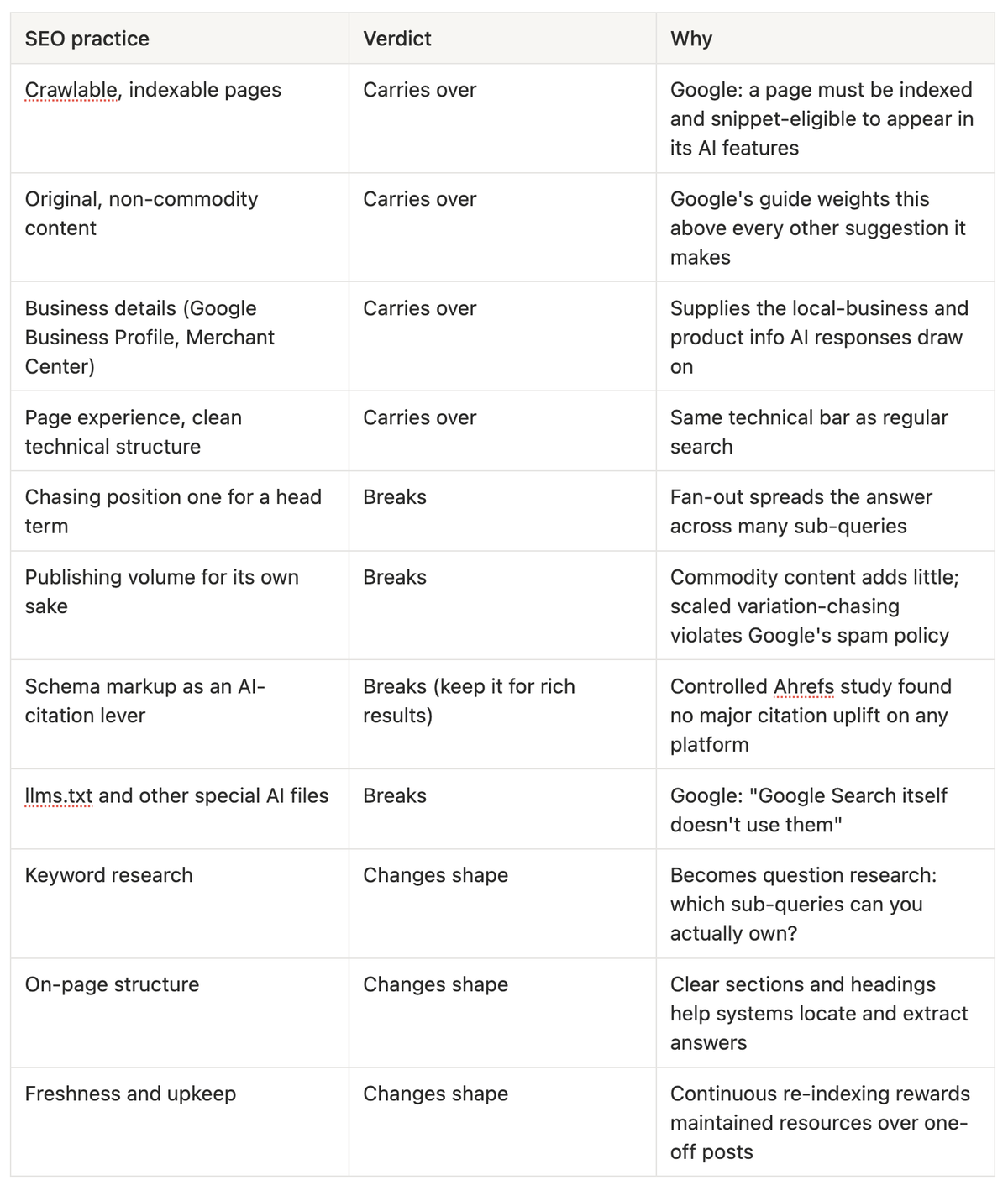
What carries over
The unglamorous plumbing survives. Google states that to be eligible for its generative AI features, a page "must be indexed and eligible to be shown in Google Search with a snippet." If your website blocks crawlers, hides content behind JavaScript errors, or duplicates itself endlessly, no amount of AI-specific tactics will help.
Content quality carries over with even more weight. Google's guide is explicit that unique, valuable, non-commodity content "will likely influence your website's presence in generative AI search in the long run more than any of the other suggestions in this guide."
Entity clarity carries over too. Keeping your Business Profile and product data accurate feeds the local-business and product listings that AI responses can include.
What breaks
Rank-one thinking breaks first. When one question becomes a set of sub-queries, holding a single position for a single head term stops being the prize. A competitor who answers three of the fan-out questions specifically can be assembled into the answer while your broad page sits at position one, uncited.
Schema-as-a-lever breaks next, and this one costs real retainer money. Ahrefs ran a controlled study of schema markup and AI citations: 1,885 pages that added JSON-LD between August 2025 and March 2026, matched against 4,000 control pages, with citations tracked across Google AI Overviews, AI Mode, and ChatGPT. Their finding: "Adding schema produced no major uplift in citations on any platform." The AI Mode and ChatGPT movements were indistinguishable from noise, and AI Overviews showed a small decline the authors could not clearly attribute to schema.
The correlation people cite in the other direction is real but misleading. Just over half of AI-cited pages carry schema, and cited pages were almost three times more likely to have JSON-LD than non-cited pages. Ahrefs' explanation: sites that add structured data also invest in technical SEO, stronger content, and links. The markup rides along with everything else. Google's guide agrees on the practical point: structured data "isn't required for generative AI search," though it remains worth keeping for rich results.
The same guide disposes of the special-file industry in one line. You don't need llms.txt files, AI text files, or new markup to appear in Google's AI features, because "Google Search itself doesn't use them."
What changes shape
Keyword research becomes question research. Instead of a list of head terms ranked by volume, you want the specific questions your buyers ask an assistant, and the sub-questions those fan out into. For a real estate agent, "homes for sale in [town]" matters less than "which neighborhoods near [town] have the shortest commute downtown" and a dozen questions like it.
On-page structure changes shape the same way. Google recommends organizing content with clear paragraphs, sections, and headings because it helps readers navigate. The practical bonus: content organized as discrete, clearly labeled answers is easier for retrieval systems to locate and use.
Freshness stops being an annual content refresh and becomes ongoing upkeep. If retrieval is continuous, a maintained resource keeps earning consideration while an abandoned post drifts stale.
Why is "just write more blogs" the worst advice of the transition?
Because the transition punishes generic volume twice.
First, commodity content loses the comparison. Google's guide draws the contrast with a real estate example: "7 Tips for First-Time Homebuyers" is commodity content that "could originate from anyone," while "Why We Waived the Inspection & Saved Money: A Look Inside the Sewer Line" offers experience only its author has. AI systems look across many sources at once. A recycled summary gets outcompeted by the one specific, first-hand account in the set.
Second, volume can now hurt you outright. The guide warns that creating separate content for every query variation "primarily to manipulate rankings or generative AI responses in Google Search" violates Google's scaled content abuse spam policy, and adds that "a high quantity of pages doesn't make a website higher quality or more relevant to users."
So the default retainer deliverable, a fixed number of generic posts per month, is the one item that lands squarely in the breaks bucket while feeling like diligence. The replacement is not silence. It is fewer, more specific, maintained resources that each answer a question someone actually asks.
How do you run the sort on your own program?
- List every recurring deliverable in your SEO retainer or internal plan: technical audits, posts per month, schema work, link outreach, reporting.
- Sort each item into a bucket using the table above. Be honest about what each deliverable is sold as. Schema for rich results carries over; schema pitched as AI visibility breaks.
- Protect the carries-over bucket. Crawlability, quality, and business-data upkeep are the entry fee. Cutting them to fund AI experiments is backwards.
- Reallocate the breaks bucket. Money spent on generic post volume or AI-markup promises moves to question-shaped resources you will maintain.
- Re-scope the changes-shape bucket. Ask your agency for a question list instead of a keyword list, and for section-level structure in everything they write.
- Add an answer check. Once a month, ask the major assistants the questions your buyers ask, and log whether you appear and who gets cited instead.
You can run step 6 by hand with a spreadsheet. If you want it continuous, a monitoring tool like Peec tracks a prompt set daily across engines and shows visibility and competitor gaps over time, which tells you whether the reallocated budget is moving anything.
For the question-shaped resource itself, here is one way we are obviously partial to. Consider the real estate agent from the sort: instead of four generic posts a month, she publishes a branded content hub with stacks for specific questions her clients ask, such as neighborhood guides and commute comparisons, each card annotated with what she actually knows about the place. It is crawlable, specific, and maintained in minutes rather than writing cycles. The companion stack for this guide is the resorted half of that list, card by card: the on-page work that still earns citations, and the evidence behind what to stop paying for.
What this sort won't do
It won't guarantee citations. Retrieval is probabilistic, answers vary between runs and engines, and nobody outside the engine companies can promise placement.
The schema verdict has a boundary. Ahrefs studied pages that were already being cited heavily. For pages AI systems have never picked up, they note markup "might still play a role" in getting crawled or parsed in the first place; their data cannot speak to that either way.
The official guidance covers Google. ChatGPT, Perplexity, and Claude publish far less about how they select sources, and their behavior differs. Treat the Google guide as the clearest public statement, not a universal law.
And the sort won't fix weak fundamentals. If your website has nothing specific to say, resorting the budget just reorganizes the silence.
Here's what to check, in order
- Your website is crawlable and indexed. Nothing else matters until it is.
- Your key pages answer specific questions, not just head terms.
- Your publishing plan produces maintained resources, not monthly volume.
- Schema stays budgeted for rich results, and nobody is billing it to you as an AI-citation lever.
- No line item promises llms.txt or "special AI markup" as visibility work.
- A monthly answer check exists, by hand or in a tracker like Peec.
- At least one question-shaped, maintained resource exists for your niche, like the agent's hub example above.
Keep the plumbing. Move the target. That is the whole transition.
Want the checklist as a working reference? The companion stack lays out the on-page GEO items card by card, including the visible-text test and the schema studies behind the verdict above.