
 Kyle Hudson, Co-Founder & CEO
 Find the questions AI can't answer yet (and own them first)
Every obvious topic in your niche is already covered. Here's how to find the specific questions AI still answers badly in your market and own them first.
You know the feeling of sitting down to plan content and finding that everything worth writing has been written. Best neighborhoods: covered. Buyer checklists: covered, forty times, by every brokerage and every national portal. Whatever you publish next joins a pile of nearly identical answers.
So most businesses do one of two things. They write the same saturated piece anyway, slightly reworded. Or they stop publishing, because what's the point.
There is a third option, and it's the one this guide teaches: stop competing on the questions everyone has answered and go find the questions people are already asking that nobody in your market has answered well. Those questions exist in every market. They are visible if you know how to look. And the first genuinely good answer to one of them tends to become the answer engines reach for.
This is step two of a two-step process. Step one is the visibility audit we covered in our guide to running your own AI visibility audit in an afternoon: derive prompts from real client questions, run them across engines, log who gets mentioned and cited. This guide picks up where that one ends, with the most valuable thing an audit produces: the list of questions where nobody won.
Why do unserved questions exist at all?
Because answer engines ask far more questions than people do.
When someone asks an AI assistant a broad question, the engine doesn't run one search. Google's own guidance describes query fan-out: the model generates a set of concurrent, related sub-queries to gather the material for its answer. "Help us relocate to Tampa" becomes questions about neighborhoods, schools, commutes, timing, paperwork, and a dozen situational variations the asker never typed.
Every one of those sub-queries needs sources. For the head questions, sources are abundant. But the further you go into specific situations, the thinner the supply gets, until the engine is assembling answers from national directories and generic listicles because nothing better exists.
Google's guidance is unusually direct about what fills that gap. It distinguishes commodity content, its example is "7 Tips for First-Time Homebuyers," from non-commodity content built on unique expertise and first-hand experience, and says creating the latter "will likely influence your website's presence in generative AI search in the long run more than any of the other suggestions in this guide."
Put those two facts together and you get the opportunity this guide is about. Demand for specific answers is generated automatically, at fan-out scale. Supply of genuinely good specific answers is thin. The space between is yours if you find it first.
What is the Unserved Question test?
Not every unanswered question is worth owning. Some are unanswered because nobody asks them. Some are unanswered by your competitors but well answered by a national platform. The filter we use is the Unserved Question test. A question is worth building on when all three conditions hold:
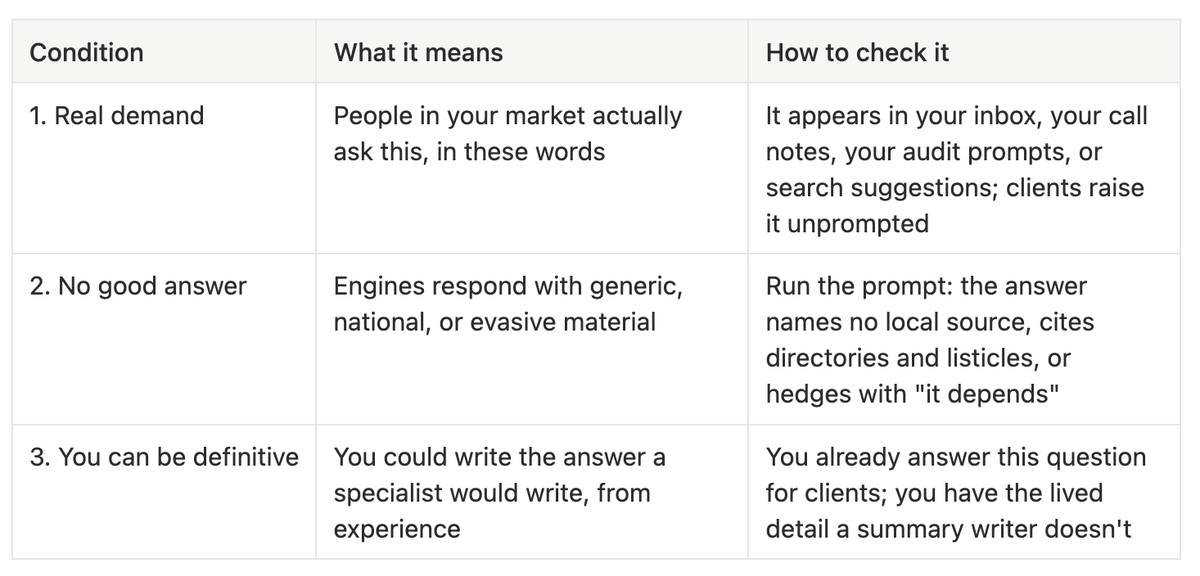
Two out of three is a trap. Demand plus a weak answer, without real expertise, produces one more thin page. Expertise plus no good answer, without demand, produces a resource nobody asks for. The test only passes when all three line up.
How do you find the gap in your market?
You need your audit log from step one. If you skipped the audit, do it first; gap-finding without a baseline is guessing.
1. Start with the nobody-zeros. In the audit, every absent result was classified two ways: questions you're losing to a named competitor, and questions where no local business appears at all. That second pile, the white space, is your raw material. Pull every prompt where the engines answered with national directories, generic advice, or nothing specific.
2. Interrogate the weak answers. For each white-space prompt, ask the engine follow-up questions the way a real client would. "Which neighborhoods work for that?" "Who should we call first?" Watch where the answer gets vague or falls back to boilerplate. The exact point where a specific question gets a generic answer is the exact shape of the resource that doesn't exist yet.
3. Check the demand side. Match each candidate question against evidence that people ask it: your inbox, your intake calls, the questions your team answers by phone every week. Search-suggestion tools and "people also ask" boxes help, but your own client conversations are the strongest signal, because they carry the situation with them. Specific search volumes for these long-tail questions are hard to verify; where you want a number, treat it as unverified rather than trusting a tool's estimate.
4. Score against the test. Run each surviving question through the three conditions. Be honest on condition three. The question you should build on is the one where your answer would be visibly better than anything the engine currently assembles, because you have done the thing, not read about it.
What comes out is usually a short list. Three to five questions. That's not a disappointment; it's a focused build plan.
What does this look like in practice?
A large Florida real estate brokerage, about 160 agents, ran exactly this exercise across its market. (Disclosure: the brokerage's owner is an advisor to Stacklist, which is how we know the story in this detail.)
The audit surfaced a pattern in the white space: relocation questions from military families. The market sits near major installations, the questions came in constantly through agent inboxes, and when those questions were put to answer engines, no competitor surfaced. The responses leaned on national moving guides and base-adjacent listicles. Real demand, no good answer, and a brokerage full of agents who had walked hundreds of military families through the move: all three conditions of the Unserved Question test, holding at once.
So instead of another round of general market updates, the brokerage built definitive military-relocation resource hubs: the timelines, the neighborhood tradeoffs by commute to base, the paperwork order, the vendors who understand the constraints, everything an incoming family actually needs, organized as browsable stacks rather than buried in one long page. The goal was simple: become the obvious source for a question set nobody else had claimed.
The method is the point here, and the method is repeatable in any market: find the question your inbox already answers weekly that the engines still answer badly.
How do you keep watching the gap?
A gap analysis is a snapshot. Markets shift, competitors publish, engines re-weigh their sources. The questions that were open this quarter may be claimed by the next one, and new gaps open as new questions emerge.
Prompt-tracking tools turn the snapshot into a standing watch. We use Peec for this. The prompts from your audit run daily across engines, and two views do the gap-finding work continuously: the gap view shows prompts where competitors appear and you don't, and the sources view shows what the engines are actually citing on each question. When a tracked prompt keeps returning answers cited to national directories and generic pages, that is the "question exists, answer isn't there yet" signal, sitting in a dashboard instead of waiting for your next manual audit. When a competitor suddenly starts appearing on a question you had marked as open, you know the window is closing.
Manual re-runs on a calendar work too. The discipline of watching matters more than the tool.
How do you build the answer once you've found the question?
Definitively, or not at all. The unserved question rewards the resource that ends the search: every sub-question a person in that situation would ask, answered in one organized place, by someone who has clearly done this before.
Structure it so both people and machines can use it. One question per section or card, direct answers up front, your first-hand specifics throughout, because first-hand perspective is exactly what Google's guidance says separates citable content from commodity content. A branded content hub is one way to do this: the brokerage's relocation resource worked as stacks of cards, each card one answer, the whole hub owning the topic. A well-structured page or resource section on your website can serve the same role. The format matters less than the completeness and the specificity.
Then maintain it. Being first earns the position; staying definitive keeps it.
What won't this method do?
Honest limits, because this method has them:
- It won't manufacture demand. If nobody asks the question, owning it is worthless. Condition one exists to stop you from building beautiful answers to imaginary questions.
- It won't work as a page-farming strategy. Google explicitly warns against creating separate thin content for every possible fan-out variation to manipulate results; that falls under its scaled content abuse policy. One definitive resource per real question, not fifty permutations.
- It won't guarantee citation. You can be the best answer and still wait for engines to find, crawl, and trust you. This is a positioning method, not a switch.
- It won't stay won on its own. An unserved question you answer well becomes a served question that competitors can study. Maintenance and depth are the defense.
Here's what to check, in order
- Finish your visibility audit and pull the white-space list: prompts where no local business was named.
- Interrogate each weak answer with follow-up questions and note exactly where it goes generic.
- Match candidates against real demand: inbox, call notes, client conversations.
- Run the Unserved Question test: real demand, no good answer, you can be definitive. All three or drop it.
- Pick your top three questions and build one complete resource for each, structured one answer per section or card.
- Put your first-hand specifics in the visible text; that's the non-commodity signal engines are told to prefer.
- Set a watch: tracked prompts or a recurring manual re-run, so you see gaps close and new ones open.
- Revisit each resource quarterly and deepen it before a competitor does.
The saturated questions in your market were once open too. Somebody answered them first, and the engines still lean on those answers. The open questions in your market are sitting in your audit log and your inbox right now.
Companion stack: an example of the method's end product. A relocation specialist's hub, where the agency, its individual agents, and its featured markets are organized as one browsable answer to a question set most competitors never claimed.