
 Kyle Hudson, Co-Founder & CEO
 The relevancy window: why your best clients forget you
Past clients loved working with you, then went quiet. The relevancy window explains why, and how publishing local knowledge keeps you visible in between.
Think about the last client who told you they would never work with anyone else. The closing gift, the thank-you note, the promise to send everyone they know. Now think about how you plan to reach that client three years from now, when they quietly start browsing again and a dozen other professionals are in front of them.
If you work in real estate, or any profession where clients transact rarely, you already know how this ends. The relationship was real. The memory fades anyway.
This guide names the problem: the relevancy window. It explains why the forgetting is structural, not personal, and it walks through a fix: publishing the knowledge you already hand out one-to-one, such as restaurant tips and contractor names, as a hub of always-useful resources, so you stay present between transactions instead of reappearing only when you want something.
Why do clients who loved working with you go quiet?
It is not betrayal. It is architecture.
Your transactional expertise, the thing clients hire you for, is intensely relevant for a narrow stretch of time: the weeks around a purchase, a listing, a contract. Outside that stretch, the client has no live use for it. They are not thinking about escrow. They are thinking about dinner.
The gap between intent and follow-through is well documented. NAR's Profile of Home Buyers and Sellers found that 90% of buyers said they would definitely use their agent again or recommend them to others — yet only 13% of buyers actually purchased their next home through an agent they'd worked with before. The loyalty is real in the moment. It just doesn't survive the gap between transactions.
Here is the framing we use at Stacklist, as an illustration rather than a measurement: a real estate agent is transactionally relevant to a given client maybe three percent of the time. The other ninety-seven percent, the agent has nothing to say that the client needs, so the follow-up defaults to "just checking in" emails, holiday cards, and market updates nobody asked for.
The client did not forget you because you mattered too little. They forgot you because you only showed up when your expertise was out of season.
What is the relevancy window?
The relevancy window is the stretch of time when your transactional expertise matters to a specific client. It opens when they enter a transaction and closes shortly after it ends. Everything you send outside the window competes for attention it has not earned.
The framework has four phases. The table below is the quick reference.
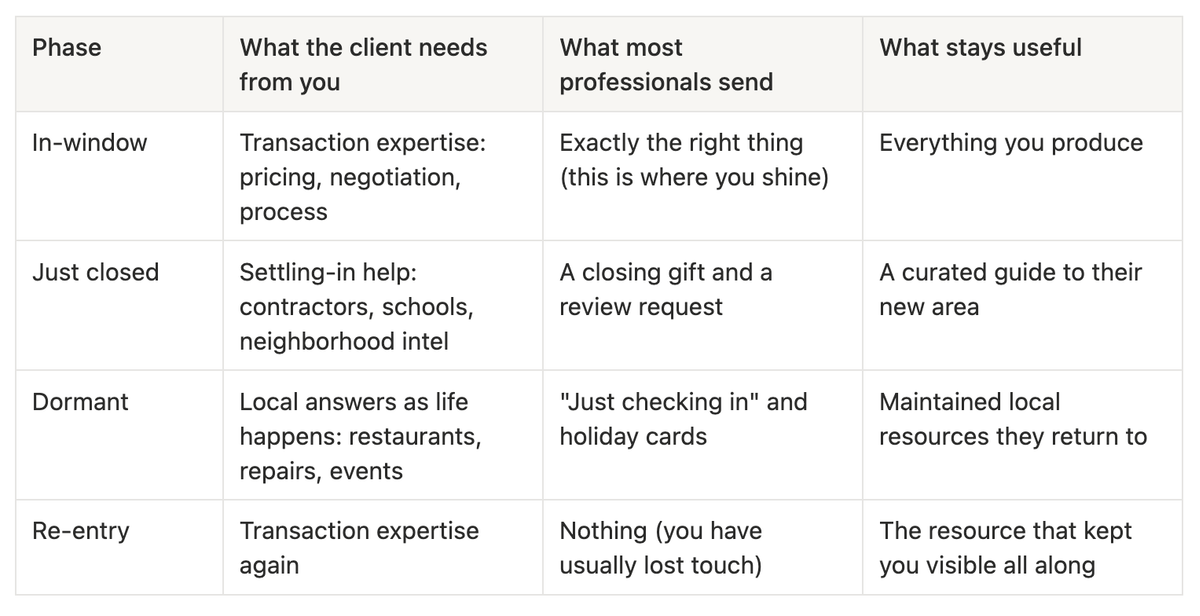
Read the two right-hand columns against each other and the diagnosis is plain. Most follow-up strategies pour effort into the dormant phase using in-window material: market snapshots, rate commentary, sale announcements. The client skims past it because it answers a question they are not asking.
But look at what you know that is never out of season. You know which inspector shows up on time. Which streets flood. Where the good coffee is. Which contractor to trust with a 1920s bungalow. That knowledge is relevant continuously, to past clients, future clients, and neighbors alike.
That is the core distinction of the framework: transactional expertise is windowed, local and domain knowledge is continuous. The professionals who stay remembered are the ones who publish the continuous layer instead of pushing the windowed one.
Why does the dormant phase matter more now?
Two shifts raised the stakes.
First, attention moved into feeds, and feeds are recency-ranked. A post about your latest closing is visible for a day or two, then buried. Publishing harder into a feed does not extend your window; it just fills the gap with noise the client tunes out.
Second, discovery moved to AI assistants. When your past client asks an assistant for family-friendly restaurants near their neighborhood, or what to know before renovating in your town, the assistant pulls from structured, crawlable resources it can find and cite. Your knowledge, currently living in one-to-one texts and emails, is invisible to that process. A maintained public resource is not.
The same shift applies beyond real estate: short-term rental managers fielding "what should we do nearby" questions, hotels competing on neighborhood knowledge, wedding planners, financial advisors, estate attorneys. Any profession with rare transactions and rich local or domain knowledge has the same dormant-phase problem and the same fix.
How do you build an always-on knowledge layer?
The fix is to take the knowledge you already give away one-to-one and publish it as maintained, browsable resources. Here is the working sequence.
- Inventory the questions you answer for free. Search your sent messages for the recommendations you repeat: contractors, restaurants, schools, "what should I know about this neighborhood." Each repeated answer is a resource waiting to be published.
- Pick the one topic where you are genuinely the expert. Not "everything about the metro area." One neighborhood, one niche, one buyer type. Depth beats breadth: a specific resource gets found by specific questions.
- Publish it as a structured, annotated collection, not a blog post. A long essay ages and gets skimmed. A collection of discrete recommendations, each with your one-line note on why it made the cut, stays scannable, quotable, and easy to update. On Stacklist, for example, an agent builds a branded content hub with stacks for restaurants, schools, trusted vendors, and seasonal events; each card carries the recommendation plus the agent's note. Any format works if it is public, structured, and maintained.
- Swap it into your follow-up. When a transaction closes, share the guide instead of a generic thank-you. When a past client asks for a plumber, answer, then add the link to the full list. The resource replaces "just checking in" with "here is something useful."
- Maintain it on a schedule. Quarterly is enough for most local resources. A restaurant closes, a vendor retires, a new coffee shop opens: fifteen minutes of pruning keeps the resource trustworthy, and trustworthy is what gets it shared and cited.
- Check whether it can be found. Ask an AI assistant the questions your clients ask ("what should I know before moving to [neighborhood]?") and see what gets cited. If nothing of yours appears, that is your gap, and your maintained resource is how you enter the answer set over time.
Notice what this costs: not new content production. You are relocating knowledge you already produce in private into a public, durable form.
What won't this do?
Honest scoping, because this method gets oversold elsewhere.
It will not generate leads next week. A knowledge layer compounds; it does not spike. The payoff arrives in the dormant phase of relationships you are building now, which means the horizon is months and years, not days.
It will not replace human follow-up. A resource keeps you findable and useful; it does not call a past client on their closing anniversary. The personal touch still belongs to you.
It will not fix a weak transaction record. Publishing neighborhood knowledge amplifies a reputation; it cannot substitute for one.
And it will not guarantee placement in AI answers. Being crawlable and structured makes you eligible for citation, not entitled to it. Treat assistant visibility as a compounding side effect of publishing genuinely useful resources, not a switch you flip.
Where should you start?
Here is what to check, in order.
- Your last five follow-ups: were they useful to the client, or just visible? If they were "checking in," you are marketing into a closed window.
- Your sent folder: which recommendations have you written more than twice? That repeated answer is your first published resource.
- Your niche: is your chosen topic narrow enough that you are plainly the person to write it?
- Your format: is the knowledge structured as discrete, annotated recommendations a reader (or a machine) can pull apart, rather than one long page?
- Your maintenance calendar: is there a recurring slot to prune and refresh, so the resource stays alive?
- Your findability: ask an assistant your clients' questions and note who gets cited today. Recheck quarterly.
The relevancy window will keep closing after every transaction. That part is structural and you cannot change it. What you can change is what remains present in the gap: not another check-in, but a resource your clients use, return to, and remember you by.
Here is the pattern end to end in a working hub: neighborhood guides, a buyer's guide, and an annotated local eats list, every card carrying the agent's own note, all maintained in one place a past client has a reason to return to.