
 Kyle Hudson, Co-Founder & CEO
 Why a human-picked list beats another AI listicle
Generic AI listicles are everywhere and say nothing. Learn the Detail Test that makes a human-curated recommendation list trustworthy and citable.
Search for "best coffee shops in [your town]" and read the first three results. Same ten places. Same adjectives. "Cozy atmosphere." "Great Wi-Fi." Nothing in any of them proves the writer ever ordered a coffee there.
Now picture the one list you actually trust. The friend who says: "Sit in the back room, the outlets run along the whole wall, and get there before 9 if you want a table." You forward that list. You go back to it.
This guide is about why that difference now decides discovery, not just taste. Specific, opinionated, personally annotated recommendations read as human, to people and to machines, and they earn citations that generic listicles don't. A real estate agent who keeps an annotated hub of neighborhood picks is publishing something a generated listicle cannot copy: proof of use. Below is how to write recommendations that carry that proof, how to test each one, and how to publish the result so it can be found.
Does human curation still matter when anyone can generate a list?
More than it did, and the engines say so themselves.
When list-making became free, lists were the first thing to flood. A model can produce "10 Great Restaurants in Marietta" in seconds, and thousands of publishers let it. The result is a wall of interchangeable pages: plausible, grammatical, and empty.
The search systems behind AI assistants are explicit about how they sort through that wall. Google's guide to succeeding in AI search tells creators to provide a unique point of view: "a first-hand review provides a unique perspective based on personal experience, whereas a summary of existing content simply restates information already available elsewhere." The same guide is blunter one sentence later: "Don't just recycle what others on the internet have already said, or could easily be produced by a generative AI model."
Google even draws the line with a worked example. Commodity content like "7 Tips for First-Time Homebuyers" is "often based on common knowledge" and "typically adds little unique insight for readers." Non-commodity content, its counterexample being "Why We Waived the Inspection & Saved Money: A Look Inside the Sewer Line," "provides unique expert or experienced takes that go beyond common knowledge."
That is a retrieval argument, not a marketing one. When an assistant assembles an answer, it compares many sources answering the same question. A page that restates the consensus adds nothing to the answer, so there is no reason to cite it. A page carrying details that exist nowhere else gives the machine something to quote.
There is a human version of the same argument, and we hear it in conversations with businesses considering curation: an annotated list gives readers a real sense that an actual person stands behind the picks. That is not decoration. That is the trust signal doing its job.
What is the Detail Test?
The Detail Test is one question, asked of every note on every recommendation:
Could only someone who actually used this write this note?
Most recommendation writing fails it. Consider the four levels a note can sit at:
- The superlative. "Amazing coffee, cozy vibes." Anyone, or anything, can write this without leaving a chair.
- The spec. "Single-origin espresso, opens at 7am, street parking." True, useful, and copied straight from the shop's website. A model can write this too.
- The usage note. "Order the cortado; the drip sits too long after mid-morning." Only a repeat customer knows this.
- The consequence note. "I stopped bringing clients here on Fridays. Live music starts at noon and you can't hear yourself talk." Only someone with history, and something at stake, knows this.
A note passes the Detail Test at level 3 or 4. Levels 1 and 2 are the tell in the other direction: they mark the list as assembled, not lived.
The test works because detail is expensive to fake and cheap to verify. A reader who visits the shop finds the outlets exactly where you said. An assistant comparing sources finds a claim it has never seen before, attached to a consistent author, on a page that keeps getting updated. Both conclude the same thing: a person was here.
What does the machine actually see: generic listicle vs annotated list?
Take one topic, work-friendly coffee shops in a single neighborhood, and put the two formats side by side.
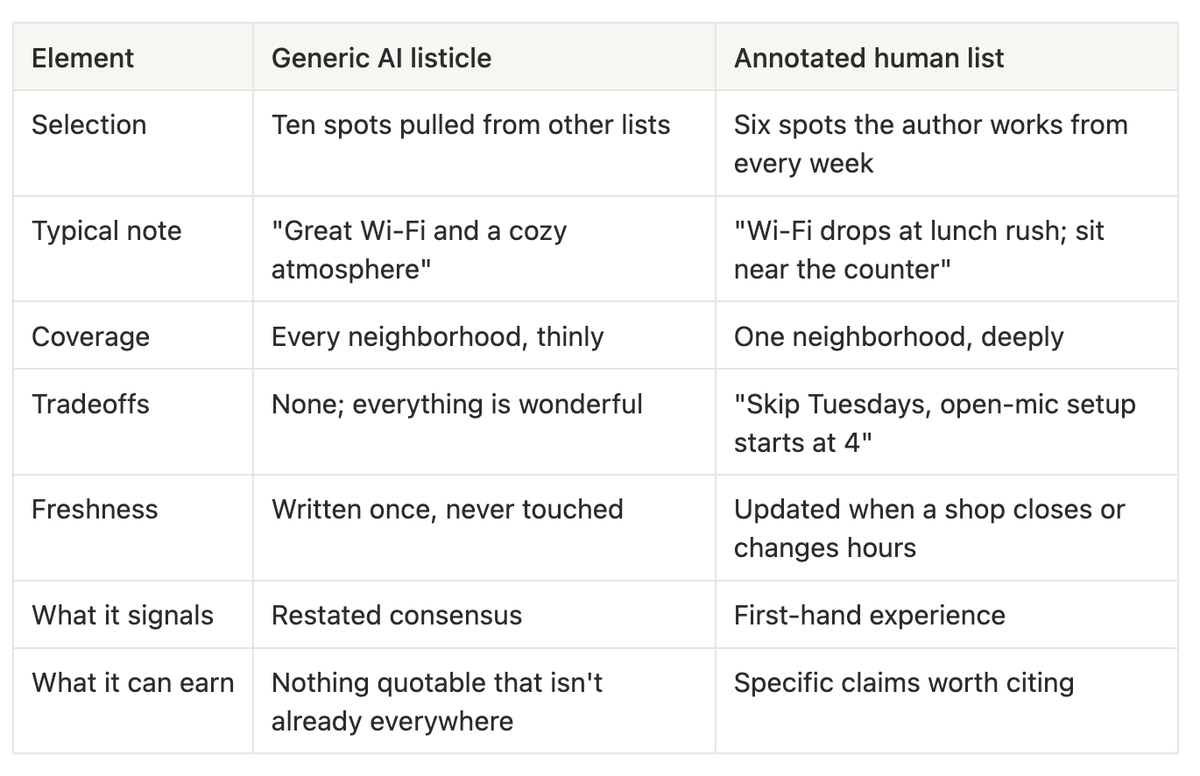
Read the table as a machine would. The left column offers no sentence that a hundred other pages don't also offer. The right column is full of sentences that exist exactly once on the internet, each one answering a narrow question someone might actually ask an assistant: "coffee shops in [neighborhood] where the Wi-Fi holds up," "quiet places to meet a client on a Friday."
How do you build a list that passes the Detail Test?
Here is the working checklist. It assumes nothing about tooling until step 6.
- Pick a topic where you have receipts. Real history, not research. A short-term rental manager knows which coffee makers survive guest turnover. A real estate agent knows which inspector answers the phone on a Saturday. Start there.
- Choose fewer items than feels safe. Cut anything you haven't personally used. A six-item list where every entry is lived beats a thirty-item list padded with consensus.
- Write one note per item, and run the Detail Test on each. If the note could have been written from the item's product page, rewrite it or cut the item.
- Include tradeoffs. At least a few notes should say when not to use the thing, or what it costs you. Uniform praise is a level-1 tell.
- Name the context. Who this list is for, what you do, why you keep it. "Gear I actually pack, after years of long trips" frames every note under it.
- Publish it as discrete, crawlable units. One recommendation, one note, one unit. On Stacklist, for example, this is a stack of cards on your hub: each card holds one pick and your annotation, and the stack has a stable public URL an assistant can read and cite.
- Maintain it. Machines keep returning to resources that change: freshness gets re-read, and a list that goes stale slowly stops being served. Swap out picks you no longer stand behind and date your updates.
- Check whether it gets served. Add the questions your list answers as tracked prompts in a monitoring tool such as Peec. Its prompt tracking and citation views show whether your list appears in AI answers, and whether it is showing up next to, or instead of, the generic listicles you are competing against.
One example, told by segment: a travel blogger built a gear stack of 38 items, each with a personal note on why that item earned its place in the bag after years of trips. That stack is the pattern in miniature: narrow topic, lived selection, level-3 and level-4 notes throughout.
What this won't do
Honest scoping, because this method has edges.
The Detail Test cannot manufacture experience you don't have. If you have never used the products or visited the places, no writing technique produces level-3 notes, and faking them puts you back in the pile you were trying to escape, with a trust problem added on.
It will not outrank entrenched authority on broad head terms. An annotated list of laptops will not displace major review publications on "which laptop should I buy." It competes where detail matters: specific contexts, specific places, specific use cases.
It does not guarantee citations. Retrieval systems weigh many signals, they differ by engine, and they change. Detail raises the odds that you are the source worth quoting; it does not control the outcome.
And it is not fast. A maintained list compounds; it does not spike. If you need visibility this week, this is the wrong lever.
Here's what to check, in order
- Topic: do you have real usage history here, or just opinions?
- Selection: did you cut everything you haven't personally used?
- Notes: does every note pass the Detail Test (level 3 or 4)?
- Tradeoffs: does the list admit when something doesn't fit?
- Context: does the list say who you are and why you keep it?
- Structure: is each recommendation a discrete, crawlable unit with its own note?
- Maintenance: is there a date on it, and a reason to update it?
- Measurement: are the questions it answers being tracked, so you can see if it gets served?
The friend with the back-room outlet tip never optimized anything. They just knew the room and said so plainly. That is the whole method: know the room, say so plainly, and publish it where the machines that answer questions can find it.
Companion stack: a working example of an annotated hub, where every card carries one pick and the note that explains it, including a curated local eats list rather than another ranked roundup.