
 Kyle Hudson, Co-Founder & CEO
 Content that compounds vs content that decays
Social posts decay in days; resources compound for years. Here's how to tell which of your content is disposable and which builds lasting AI visibility.
Open your analytics and look at a social post from six weeks ago. Not six years. Six weeks.
Whatever that post earned, it earned in the first two days. After that it stopped working, and nothing you do will put it back to work. The reach is spent. The knowledge inside it, the thing that took you years to learn and twenty minutes to write down, is buried under everything you and everyone else have published since.
This is the quiet problem with the "post consistently" playbook that every real estate agent, short-term rental manager, and local operator has been handed. The work is real. The output evaporates. Meanwhile a maintained resource, a neighborhood guide, a trusted-vendor list, a hub of answers to the questions clients actually ask, keeps earning attention long after the week it went up.
The difference is not effort or talent. It is architecture. Some content sits on surfaces that decay by design. Some sits on surfaces that compound. This guide is about telling the two apart, and about moving your knowledge from the first kind to the second.
Why does relentless posting produce nothing durable?
Feeds are ranked by recency and engagement. That is the whole mechanism. A post surfaces because it is new, and it stops surfacing because something newer arrived. Your market update from March is not ranked below a competitor's update from yesterday. It is not ranked at all.
So decay is not a quality problem. A brilliant post decays on the same curve as a lazy one; the brilliant one just starts from a higher peak. You cannot out-write a surface whose job is to move on.
It also means volume does not accumulate. Each new post is a fresh lease on attention with the same expiration date. Posting more raises the average height of the peaks and does nothing to the slope of the decline. When a real estate agent says content feels like running to stand still, this is the mechanism they are describing.
One more cost is easy to miss: posts do not reference each other. Fifty posts about a neighborhood are fifty disconnected fragments. Nobody, human or machine, can browse them as a body of knowledge. The expertise is there, but it has no shape.
What makes content compound instead?
Resources live on a different surface: search. A resource does not surface because it is new. It surfaces because it matches a question someone just asked. As long as people keep asking the question, and your resource keeps being a good answer to it, it keeps getting served. Time stops being the enemy.
This has always been how search engines work, and it carries directly into AI-generated answers. Google states that its generative features in Search are "rooted in our core Search ranking and quality systems" in its guide to AI features. When an AI assistant answers "what should I know before moving to this neighborhood?", it is retrieving from an index of durable, crawlable pages. A feed post from March was never in the running. A maintained guide is.
Compounding also used to carry real risk, which is why an older generation of advice told agents and site owners to leave a ranking page alone. I remember that era. Even if you tear down your website and do a new one, unless you try to mirror or match every single piece of content you did previously, it's all going to shift and change. It used to be a lot more fragile. You couldn't touch anything, because it took weeks for things to re-index.
That fragility has mostly gone. Crawlers now revisit useful pages constantly, checking up on fresh material on a regular basis. The practical consequence: edits to a maintained resource, a corrected vendor listing for instance, get picked up in days, not weeks. Maintenance now adds value instead of threatening it.
How do you tell compounding content from decaying content?
Use a simple sorting device we call the Half-Life Ledger. Take everything you published last quarter and ask two questions of each piece:
- The question test. Will someone still be asking the question this piece answers a year from now? "Just listed!" fails. "Which schools serve this zip code?" passes.
- The accumulation test. When you next touch this topic, will the work make an existing asset stronger, or will it start a new item from zero? A new post starts from zero every time. An updated guide gets stronger.
Anything that passes both is compounding content. Anything that fails both is decaying content. It is fine to produce decaying content on purpose, for reach or for announcements. The mistake is producing only decaying content and expecting a durable result.
Here is how common content types sort out:
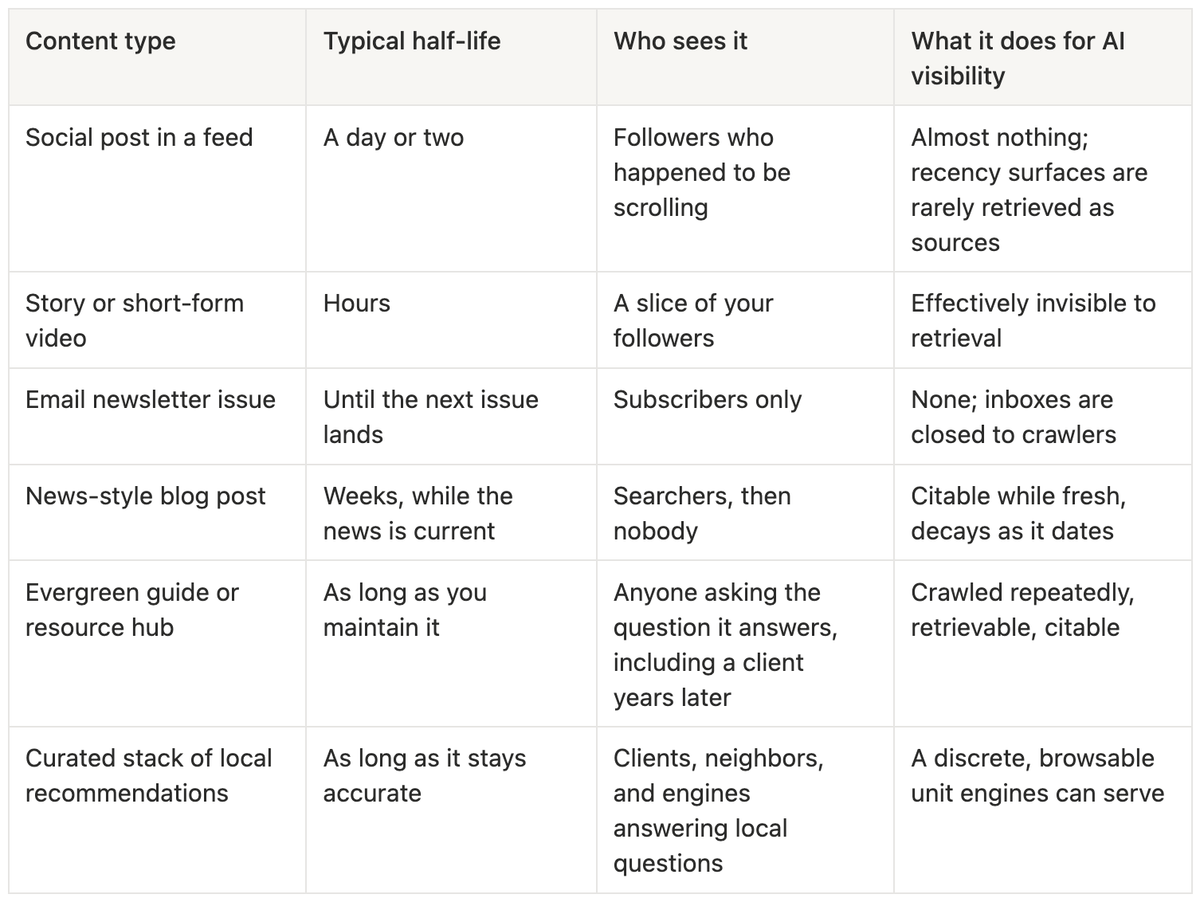
The half-lives above are structural characterizations of how each surface ranks content, not measured figures; your numbers will vary with audience and topic.
How do you move your knowledge into compounding form?
You do not need to stop posting. You need a second track. Here is the sequence we recommend.
1. Pick the durable questions. List the ten questions clients ask you in person, every year, regardless of market conditions. For a real estate agent: which neighborhoods fit which budgets, which inspectors to trust, what closing actually costs. For a short-term rental manager: what to do in town, where to eat, how to get around. These are your compounding candidates.
2. Consolidate what you already made. You have probably answered each question a dozen times in scattered posts. Pull those answers into one resource per question. This is consolidation work, not new writing, and it is where most of the early gains are.
3. Give each resource a permanent, crawlable address. A resource that lives inside a feed or an inbox cannot compound. It needs an open web page with a stable URL. This is the job a branded content hub does: for example, an agent on Stacklist keeps a stack of neighborhood restaurant cards, a stack of trusted vendors, and a stack of moving-day resources, each browsable at a public link they can also hand to a client after a meeting.
4. Put maintenance on a schedule. A monthly half-hour pass per resource: fix what changed, add what you learned, remove what died. Because re-indexing is now fast, each pass propagates quickly. This is the step that separates an evergreen resource from an abandoned page.
5. Measure the compounding, not the spike. Decaying content is measured in first-week reach. Compounding content is measured in whether it keeps getting crawled, served, and cited months later. Server logs show the crawling layer; peec.ai's guide to server logs for AI search is a good primer on reading them. For the serving layer, a tracker like Peec runs your target prompts daily; a useful check to run each quarter, in Peec's dashboard or through its MCP connection, is:
"For my tracked prompts, compare this month to three months ago: is my domain still being mentioned and cited? Which of my pages are crawled most often, and are those the pages being cited?"
A resource that holds or grows on that report is compounding. We have seen this pattern in the wild, for example with niche stacks that keep drawing AI traffic long after publication.
What won't this approach do?
Honest scoping, because compounding gets oversold.
It will not give you reach this week. Feeds are genuinely better at immediacy: announcements, open houses, listings, personality. Keep them for that. A resource earns attention slowly and holds it; it does not spike.
It is not set-and-forget. An unmaintained "evergreen" page decays too, just on a slower curve. Dead links and stale recommendations erode trust with readers and, eventually, with the engines citing you. If you will not maintain it, do not build it.
It will not rescue thin content. Consolidating ten shallow posts produces one shallow page. The compounding surface rewards resources that are actually good answers.
And it guarantees nothing about citations. Being crawlable and durable makes you eligible to be served by AI assistants; it does not make you inevitable. Competitors maintain resources too.
Here's what to check, in order
- Run last quarter's output through the Half-Life Ledger: the question test and the accumulation test. Count how many pieces pass both.
- Write down the ten durable questions clients ask you every year.
- For each question, consolidate your scattered answers into one resource.
- Confirm every resource has a permanent public URL a crawler can reach, whether that is a page on your website or a stack in your hub.
- Set a monthly maintenance pass and put it on the calendar.
- Check the crawling layer in your server logs, and the serving layer with a prompt tracker like Peec, quarterly.
- Keep posting to feeds for reach, but make each post point back to the resource it came from.
Collections compound. Feeds decay. The playbook is not to abandon one for the other; it is to stop expecting feed content to do a resource's job.
To see the lesson working, browse a hub that has been compounding for over a year: neighborhood guides, a buyer's guide, active listings, and a curated local eats list, all kept current in one place instead of scattered across a feed.