
 Kyle Hudson, Co-Founder & CEO
 Your podcast back catalog is invisible to AI search
Your podcast back catalog is full of expertise AI can't hear. Here's how to make individual episodes citable with transcripts, chapters, and resource pages.
You have eighty episodes. Somewhere around episode 30 you spent an hour with a guest dismantling exactly the question a stranger just typed into ChatGPT. The answer they got back cited a blog post, a Reddit thread, and a YouTube video from a creator you have never heard of. Your episode, the better answer, appeared nowhere.
This is the standard experience for podcasters, and it is not a quality problem. Hundreds of hours of real expertise sit in your back catalog, and answer engines behave as if none of it exists.
The reason is simple and fixable: audio is opaque to these systems. What they retrieve and cite is the text and structure around your episodes. A branded content hub of episode resources, the kind a host can build in a weekend and maintain in minutes per episode, is the difference between a catalog machines can quote and a catalog they cannot see. This guide explains what the research shows about which video and audio content gets cited, and how to build the missing layer.
Why can't AI search hear your episodes?
An answer engine assembling a response does not listen to audio. It retrieves documents: pages, transcripts, descriptions, structured text it can parse in milliseconds. An MP3 in an RSS feed offers it almost nothing to work with. Even a YouTube upload of your episode is only as visible as the text attached to it: the title, the description, the transcript, the chapter markers.
So when your episode fails to appear in an answer, the machine has not judged your conversation and found it lacking. It never encountered the conversation at all. It encountered a thin wrapper: a two-line description, an auto-generated transcript nobody structured, a title written for loyal subscribers rather than for a question someone might ask.
One honest caveat before the data: no public study isolates podcast episodes as a citation category. What exists is solid research on when AI systems cite video, especially YouTube, where most podcasts already publish. The podcast application in this guide is an inference from those findings plus the mechanics above. We will flag where the evidence ends and the inference begins.
What does the research actually say about video citations?
Three independent datasets point the same direction: video gets cited heavily, and what earns the citation is reference value, not popularity.
Video presence tracks brand visibility. Ahrefs analyzed 75,000 brands and found that YouTube mentions were the strongest single correlate of brand visibility in AI answers, at roughly 0.737, ahead of every other factor they tested, including branded web mentions and domain rating. Ahrefs is explicit that this is correlation, not causation.
Video gets cited even where it doesn't rank. In a separate Ahrefs study of 4 million AI Overview citations, among cited pages that did not rank in Google's top 100 results for the query, 18.2% were YouTube URLs. YouTube is also cited more than any other domain in AI Overviews, with citations up 34% over six months.
But the effect is platform-specific. BrightEdge's monitoring puts YouTube at about 20% average citation share across AI platforms, including 29.5% of Google AI Overviews, yet near zero in ChatGPT (0.2%). OtterlyAI's data shows the same split: Perplexity (38.7%) and Google AI Overviews (36.6%) drive most YouTube citations, while Gemini (0.2%) and Copilot (0.5%) rarely cite it. Video visibility today is a Google-surfaces-and-Perplexity story. Text pages carry ChatGPT.
Then comes the finding that should reorganize how every podcaster thinks about their catalog. OtterlyAI's 2026 study of YouTube citations across AI platforms found:
- Long-form dominates. 94% of YouTube AI citations went to long-form videos; Shorts got 5.7%. Podcasts are long-form by nature. The format bias runs in your favor.
- Popularity signals barely register. Correlations between citation frequency and views, likes, and subscribers were near zero (views at -0.03). These figures describe videos that were already cited at least once, so they explain repeat citations, not initial discovery, and they are associations, not causes.
- Small channels get cited. 40.83% of cited videos had under 1,000 views, and 35% of cited channels had fewer than 10,000 subscribers. The median cited channel had 41 videos: about the size of a podcast back catalog after a year and a half of weekly episodes.
- Structure earns repeat citations. 78% of videos cited with timestamps were cited multiple times, often across two to five different chapters. Timestamped citations appeared only in Google's surfaces (73% in AI Overviews, 27% in AI Mode).
Read those together and the pattern is clear: answer engines treat structured long-form video the way they treat a well-organized reference page. A three-year-old episode with 400 views can be citable. What it needs is text and structure, and that is exactly what most back catalogs lack.
What makes an episode citable? The Citable Episode anatomy
We think of a citable episode as three layers stacked on top of the audio. Most podcasts ship layer zero (the audio) and stop.
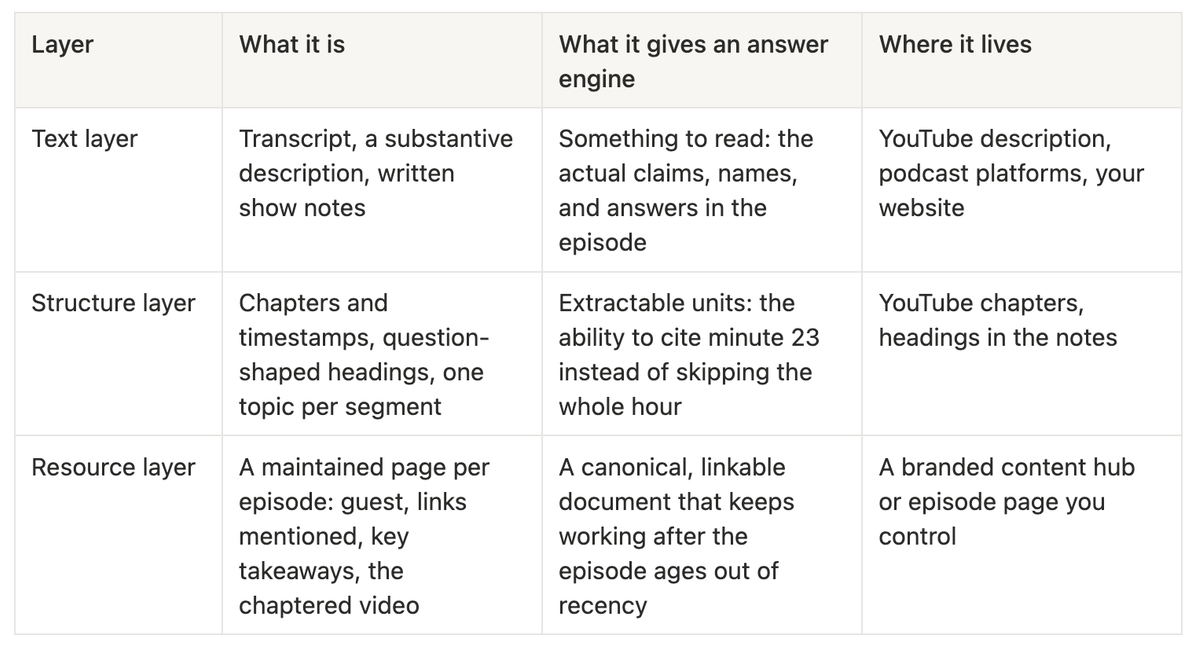
The layers compound. A transcript with no structure is a wall of text; machines can read it but struggle to extract from it. Structure with no resource layer lives entirely inside YouTube, useful on Google surfaces and Perplexity, invisible where engines prefer open web pages. The resource layer is what makes one conversation citable everywhere, including the text-first engines that rarely touch video.
The structure layer has documented mechanics. For YouTube chapters to render, the platform requires the first timestamp at 0:00, at least three timestamps, and a minimum chapter length of ten seconds. Treat those the way you treat heading structure on a web page: formatting requirements for machine readability. OtterlyAI's description-length finding points the same way: description word count showed one of the few meaningful positive associations with repeat citations (0.31), consistent with descriptions functioning as machine-readable metadata rather than marketing copy.
How do you build the resource layer for a back catalog?
You do not need to remaster anything. You need a repeatable per-episode workflow, then a triage pass over the archive.
Step 1: Pick the ten episodes worth retrofitting first. Not your most downloaded; your most reference-shaped. Episodes that answer a question a stranger would actually ask: how to price something, how a process works, what a specific mistake costs. Evergreen beats topical.
Step 2: Get a real transcript. Auto-captions are a floor. Clean up names, correct the terms of art, and fix the sentences where the transcription mangled the one quotable line.
Step 3: Chapter the video version. Watch for the natural question boundaries in the conversation and mark them: first chapter at 0:00, at least three chapters, each at least ten seconds. Name chapters as questions or claims ("Why home inspections fail in older neighborhoods"), not as segments ("Part 2").
Step 4: Rewrite the description as metadata. One plain-language paragraph summarizing what the episode answers, the guest's name and role, the entities and tools discussed, the chapter list, and links to the resources mentioned.
Step 5: Build the episode resource page. This is where the catalog becomes a library. One page per episode: who the guest is, the three to five takeaways in plain declarative text, every link mentioned, and the chaptered video embedded. Here is where we would show Stacklist doing the job, because this is what stacks are for: a host creates one stack per episode, with cards for the guest, the takeaways, each resource mentioned, and the video itself. A real estate team running a local-market podcast, for instance, ends up with a browsable hub where every episode is a small, structured answer page, and every recommendation in three years of conversations is a card a machine can read. The same layer can be built as plain pages on your website; the point is that it exists, is crawlable, and is maintained.
Step 6: Interlink and keep it current. Link episode resources to each other by topic. When a fact in an old episode expires, note the update on its resource page. A maintained page signals ongoing reference value in a way a dated upload cannot.
Step 7: Watch whether it works. Write down ten questions your best episodes answer, phrased the way a stranger would ask them. Run them monthly across ChatGPT, Perplexity, and Google's AI surfaces and log who gets cited. We do the continuous version of this in Peec: register the prompts once, let them run daily, and watch whether your episode resources start showing up as sources against the competitors currently filling that space.
What won't this fix?
Honest limits, because this method has them.
It will not put you in ChatGPT via YouTube. The platform data is unambiguous: ChatGPT cites YouTube at 0.2%. For text-first engines, the resource layer on the open web is doing the work, and that layer competes with every article on the topic.
It is not a proven podcast playbook. The citation studies measure YouTube videos generally, not podcasts as a category. We consider the inference sound, because the mechanism (text and structure around long-form content) is the same, but nobody can show you podcast-specific citation numbers today, including us.
It will not rescue episodes with nothing extractable in them. A meandering chat with no clear claims produces a resource page with nothing on it. The retrofit rewards episodes that answered something.
And the correlations are correlations. Structure is associated with repeat citations among videos already being cited; no study shows that adding chapters causes a first citation. What structure demonstrably does is make extraction possible. It removes your disqualification; it does not guarantee selection.
What to check, in order
- Search your own catalog's questions in ChatGPT, Perplexity, and Google AI Overviews. Log who gets cited today.
- Confirm your episodes exist as long-form YouTube uploads, not only as audio in podcast apps.
- Pick the ten most reference-shaped episodes in the archive.
- For each: clean transcript, chapters (0:00 start, three minimum, ten seconds minimum), metadata-grade description.
- Build one resource page per episode: guest, takeaways, links mentioned, embedded chaptered video.
- Interlink resource pages by topic and put them somewhere crawlable that you control.
- Re-run your question set monthly, manually or with a tracker like Peec, and judge the trend.
Your back catalog is not thin content waiting to be promoted. It is a reference library that was never given a spine. Machines cite what they can read; give them something to read.
Here's the companion stack for this guide: one long article rebuilt as thirteen standalone atoms, shown beside the original. It is the same operation an episode needs, one medium over. Take the thing that was published whole, and give every answer inside it its own address.