Your reviews are trapped where AI can't cite them
Your five-star reviews live on Yelp and Google, but AI assistants rarely cite them. Here's the Proof-Surfacing Pattern that makes your reputation citable.
Stacklist Team
Oct 7, 2026 · 8 min read
Somewhere on Google, Yelp, or Facebook there is a version of your business that looks exactly the way you want it to look. Years of reviews. A strong rating. Replies that show you pay attention. Proof, accumulated one customer at a time.
Now ask ChatGPT or Perplexity who to hire for what you do in your town. Read the answer carefully. You are probably not in it, and neither is a single one of those reviews.
That gap is not a reputation problem. It is a location problem. Your proof lives inside platforms that AI assistants rarely walk through when they compose an answer. This guide explains why that happens and shows you how to move a copy of your proof somewhere citable, using a pattern any local expertise business can apply in a week.
Why doesn't AI cite reviews you can see right there on Google?
When someone asks an AI assistant for a recommendation, the assistant searches the open web, reads pages it can fetch and parse, and cites the sources it used. Your reviews fail that pipeline at three separate points. Call them the three walls.
The platform wall
Review platforms are built to keep readers inside. Logins, interstitials, app prompts, and terms of service all work against a machine that just wants to read a page and move on.
You can see the result in citation data. Profound analyzed 680 million AI citations from August 2024 to June 2025 and found that even on Perplexity, the engine friendliest to review platforms, Yelp accounted for 0.8% and TripAdvisor for 0.6% of total citations.
On ChatGPT the picture is starker: its citation mix leans heavily on Wikipedia (7.8% of all citations in the same study) and established media, with consumer review platforms absent from its top sources entirely.
And notice what gets cited when a review platform does appear in an answer: the platform. The link goes to yelp.com or tripadvisor.com. Every review a customer leaves there compounds that domain's authority, not yours.
The rendering wall
Even the reviews you display on your own website are often invisible to AI systems. searchVIU ran controlled tests in October 2025 and found that AI chatbots fetching a page directly extract only visible HTML content: none of the five systems tested read JSON-LD schema markup during a direct fetch, and ChatGPT's fetcher did not execute JavaScript at all.
Think about what that means for the standard setup. A review widget that loads by JavaScript. A star rating that exists only in schema markup. A testimonial carousel. To a human visitor, proof everywhere. To an AI system fetching the page, mostly blank space.
The attribution wall
Google's guide to succeeding in AI search makes the underlying rule plain: generative AI features work from publicly accessible, crawlable content. It also notes that a first-hand review provides a unique perspective based on personal experience, exactly the kind of content these systems value.
Your customers have already written that content. It is public and it is crawlable. It just is not attributable to you, because it lives on a domain you do not control, in a format built for browsing rather than citation.
What is the Proof-Surfacing Pattern?
The fix is not to abandon review platforms. Keep earning reviews where customers already look. The fix is to surface that proof: maintain one open, structured, crawlable resource on the web that aggregates it, so an AI system composing an answer about your category has a page about you worth citing.
We call this the Proof-Surfacing Pattern. It has four stages: collect, aggregate, structure, link.
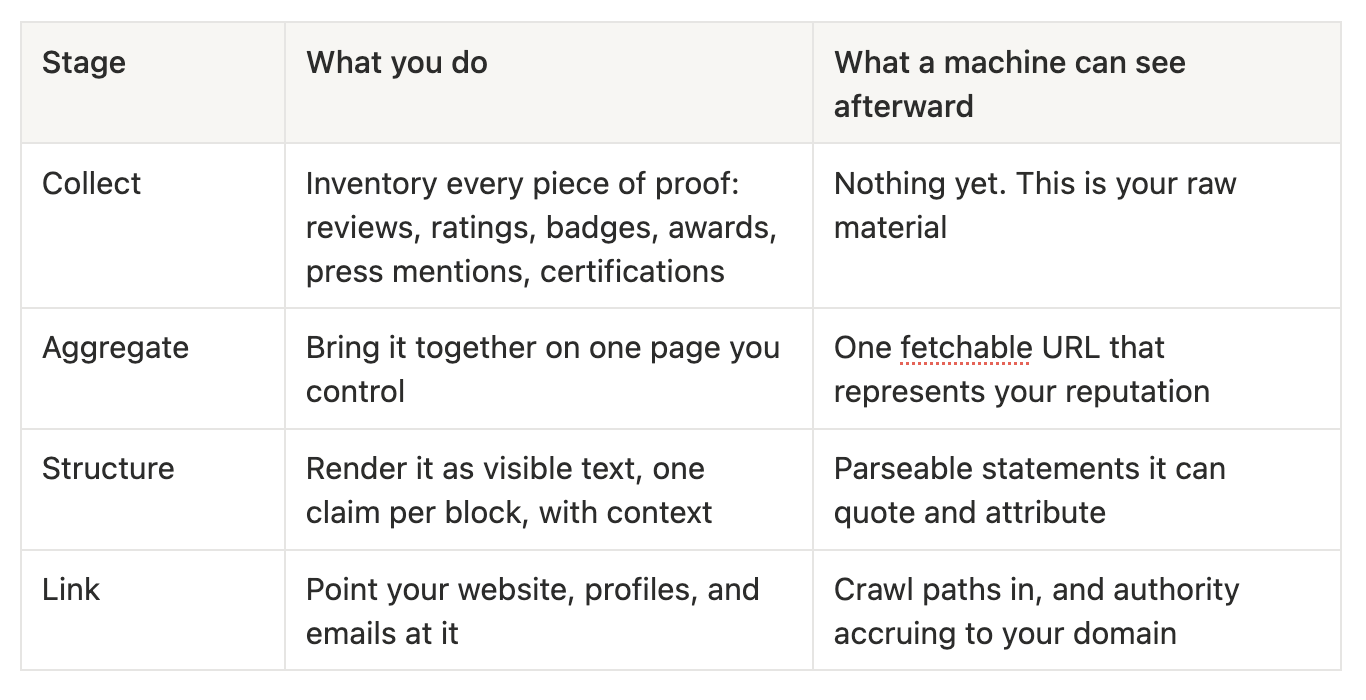
The order matters. Aggregating before collecting produces a thin page. Structuring before aggregating polishes fragments nobody can find. Work down the table.
How do you build a citable reviews hub, step by step?
1. Collect your proof
List every place your reputation lives: Google Business Profile, Yelp, Facebook, industry directories, association memberships, local press, awards. For each source, capture the rating, the review count, and two or three specific reviews that describe the work, not just the feeling. "They handled everything within a day and explained each step" beats "Great service" because it answers questions a person actually asks.
Check each platform's terms before republishing full review text. Summaries, ratings, counts, and links back to the source are the safe backbone; quoted excerpts with clear attribution are worth the extra diligence.
2. Aggregate onto one open page
Create a single page on the open web whose only job is to hold your proof. Not a homepage section that rotates three testimonials. A dedicated, stable URL: your reviews, your ratings across platforms, your credentials, in one place.
This is where a branded content hub earns its keep, and it is how we would do it on Stacklist. Create a hub for your business, then add a stack for your proof: one card per source. A card for your Google rating and count, linking to the profile. A card per notable review excerpt. A card for each award or certification, linking to the issuer. The stack becomes a browsable, shareable reviews hub at a public URL, and every card keeps a live link back to where the proof originated, so anyone (human or machine) can verify it at the source.
You can build the same thing as a plain page on your website. The pattern is what matters, not the tool.
3. Structure it for extraction
Remember the rendering wall: visible text wins.
- Write one claim per block: source, rating, count, date range, in plain words. "Rated 4.9 on Google across 212 reviews as of June 2026" is a sentence a machine can lift whole. Use your own rating, count and date, not these.
- Give each excerpt context: what service, what situation, when. Uncontextualized praise is unquotable.
- Add a short FAQ in the same voice your customers use: "Is [business type] in [town] reliable?" followed by a direct answer grounded in the proof above.
- Skip anything that only exists inside a widget, a screenshot, or schema markup. If you cannot select the text in your browser, assume an AI fetcher cannot read it.
4. Link it into the web
A page nobody links to is a page crawlers deprioritize. Link the reviews hub from your website navigation and footer, your Google Business Profile, your email signature, and your social profiles. When you reply to a happy customer, send them there. Each link is both a crawl path and a signal that the page matters.
One cremation-services company we work with ran exactly this play: reviews scattered across platforms, aggregated into one open resource in a single week. We have since seen that page turn up in assistant answers about providers in their area. We are not attaching a timeline or a number to that, because we have not measured it properly. The point is the shape of the move, not a benchmark.
How do you know it's working?
You cannot manage what you never observe, and there is no Search Console for ChatGPT. Two ways to watch.
The manual way: write down the ten questions a customer would ask an AI assistant about your category and town ("best cremation services in [city]", "who should I trust for [service] near [neighborhood]"). Ask them across ChatGPT, Perplexity, and Google's AI Mode once a month. Log who gets mentioned and which URLs get cited. It takes an hour.
The continuous way is a monitoring tool. In Peec, add those same questions as tracked prompts and let them run daily. The dashboard shows how often your business is mentioned, which URLs the engines cite in those answers, and who wins the prompts you lose. After you publish your reviews hub, watch for its URL appearing in the citation list: that is the pattern doing its job.
If you have the Peec MCP connected to Claude, you can query it conversationally:
- "Which of my tracked prompts mention my business, and which URLs are cited in those answers?"
- "List the domains cited most frequently for my prompts about [service] in [city], and whether my reviews page appears."
Either way, the metric is the same: your proof page moving from absent to cited.
What this won't do
Honest scoping, before you invest the week.
This pattern will not manufacture a reputation. It surfaces proof that already exists. If the reviews are thin or poor, aggregation just makes that easier to read.
It will not replace review platforms. Customers still check Google and Yelp directly, and those profiles feed your hub. Keep earning reviews there.
It will not guarantee citations. Engines differ sharply in what they cite, and their behavior shifts. A well-structured proof page makes you citable; it does not make any engine cite you on a schedule.
And it will not fix a weak underlying web presence. If your website is uncrawlable or your business entity is ambiguous across the web, solve that first.
Bringing it together: here's what to check, in order
- Ask three AI assistants for a recommendation in your category and town. Note whether you appear and what gets cited.
- Inventory your proof: every platform, rating, count, award, and press mention.
- Confirm the republishing rules for each platform you draw from.
- Publish one open, dedicated page that aggregates the proof, on a URL you control.
- Verify it reads as visible text: select every claim in your browser; no widget-only or schema-only proof.
- Add context and an FAQ so each block answers a real customer question.
- Link the page from your website, profiles, and email signature.
- Set up tracking, manual log or Peec prompts, and watch for your URL in citations.
- Revisit monthly: add new reviews, refresh counts, keep the page maintained rather than finished.
Your customers already wrote the case for hiring you. Right now it sits behind three walls, compounding someone else's domain. Move a copy into the open, structure it so a machine can quote it, and the next time an assistant answers "who should I use?", there is finally a page about you worth citing.
Companion stack: see the pattern built end to end in our reviews-hub template.
Originally published on the Stacklist blog.